
For generations, the rhythm of Manhattan was easy to recognize.
Every morning, millions of people poured into office buildings. Every evening, they poured back out.
Then the pandemic disrupted that rhythm.
Remote and hybrid work changed how companies use office space, leaving some older commercial buildings struggling to compete for tenants. At the same time, New York City’s housing shortage became increasingly difficult to ignore.
Now, those two challenges are colliding in a way that could reshape entire Manhattan neighborhoods.
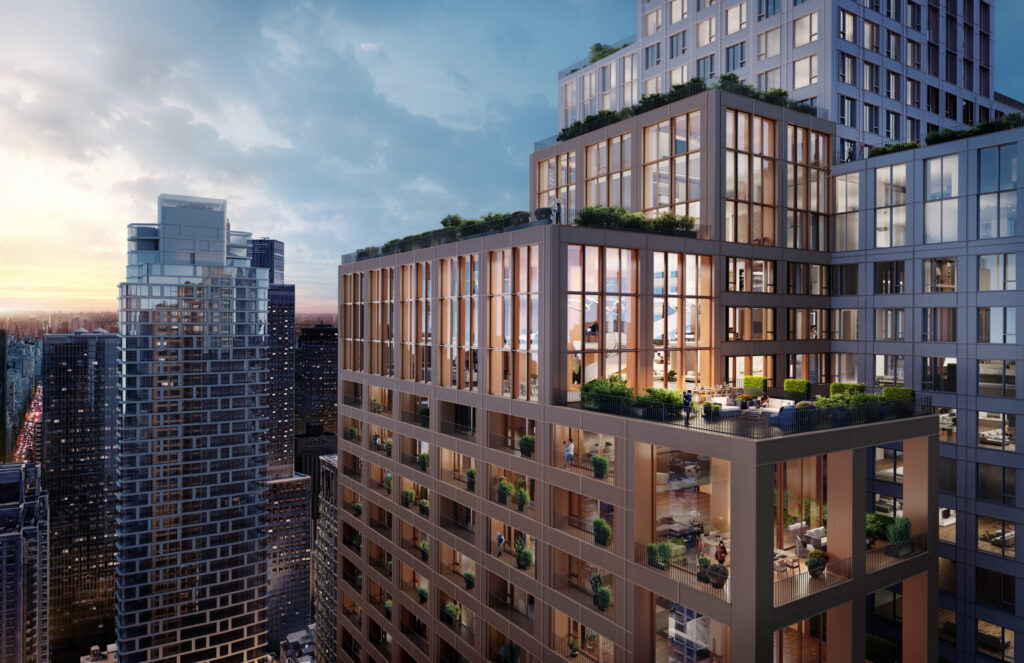
Office buildings are becoming apartments.
And what began as a handful of ambitious redevelopment projects is quickly becoming a much larger part of New York’s housing conversation.
Why Convert Offices Into Homes?
At first glance, the idea seems obvious.
New York has underused office space. New York desperately needs housing.
Why not turn one into the other?
The reality is considerably more complicated, but recent changes to city and state policy have made conversions possible for a much larger collection of buildings.
New York State created the 467-m tax incentive, which provides property-tax benefits for qualifying commercial-to-residential conversions that include affordable housing. The state also removed the longstanding residential floor-area-ratio cap that had prevented certain high-density commercial buildings from becoming equally dense residential properties.
Meanwhile, zoning changes through New York City’s City of Yes initiative expanded the universe of buildings eligible for residential conversion.
The result?
New York is effectively telling developers: if an office building is no longer working as an office, let’s see whether it can work as a home.
And This Is Already Happening
This isn’t a hypothetical plan for the distant future.
At 25 Water Street in the Financial District, a former office building has already been transformed into 1,320 apartments, including 330 income-restricted homes. The project became the first conversion to utilize the 467-m tax exemption.
Then there is one of the most ambitious projects underway in Midtown East.
The former Pfizer headquarters at 219 and 235 East 42nd Street is being transformed into more than 1,600 apartments, including over 400 affordable units. When completed in 2027, the project is expected to be the largest office-to-residential conversion in New York City history.
And perhaps nowhere is the shift more symbolic than Times Square.
At 5 Times Square, the former Ernst & Young headquarters is slated to become as many as 1,250 apartments, including approximately 313 permanently affordable homes. The building had an office vacancy rate of 77% when the conversion plan was announced.
A building designed at the beginning of this century to house thousands of office workers could soon house New Yorkers instead.
That’s a remarkable shift in just over two decades.
Could Conversions Actually Make a Difference?
Potentially, yes.
According to analysis from the New York City Comptroller, the pipeline of Manhattan office buildings south of 59th Street that could qualify for 467-m benefits could produce approximately 14,500 apartments, including around 3,600 income-restricted units.
State officials have also said that zoning changes under City of Yes could make as much as 120 million additional square feet eligible for conversion, with the potential for up to 18,000 new homes.
For a city where housing production routinely struggles to keep pace with demand, those are meaningful numbers.
But perhaps the more interesting impact isn’t simply how many apartments get created.
It’s where they’re being created.
Midtown Could Become More Residential
Think about Midtown Manhattan after 6:00 p.m. twenty years ago.
Many blocks were overwhelmingly commercial. People arrived in the morning, worked, ate lunch, and left.
That is already changing.
If office conversions continue, neighborhoods that historically revolved around the workday could become increasingly residential.
More residents mean demand for grocery stores, restaurants, gyms, schools, neighborhood services, green space, and everything else people expect within walking distance of home.
Midtown East doesn’t stop being a business district because several office towers become apartments.
But its identity begins to broaden.
The same thing happened in Lower Manhattan.
The Financial District was once overwhelmingly dominated by offices. Decades of residential conversions helped transform it into a neighborhood where people don’t simply work.
They live there.
Midtown may now be entering its own version of that evolution.
But You Can’t Turn Every Office Into an Apartment
This is where the idea becomes more complicated.
Office buildings and apartment buildings are designed very differently.
Many modern offices have enormous floorplates, meaning the center of the building can be far from exterior windows. That’s perfectly fine for conference rooms, storage, elevators, or office corridors.
It’s much harder when you’re trying to create bedrooms and living rooms that require access to natural light.
Developers may need to carve out courtyards, remove portions of floors, redesign mechanical systems, relocate elevators, replace façades, or even add new floors to make a conversion work.
The former Pfizer headquarters demonstrates just how extensive these transformations can become. Plans include adding 19 stories to one of the existing buildings while substantially reconfiguring the neighboring tower.
So when people talk about “turning offices into apartments,” we’re often talking about major redevelopment projects, not simply moving out the desks and installing kitchens.
What Does This Mean for New York Real Estate?
The long-term impact could be significant.
New York has historically separated many of its neighborhoods by purpose.
This is where we work.
This is where we live.
This is where we shop.
Office conversions blur those lines.
They create opportunities for business districts to become genuine mixed-use neighborhoods, with activity extending beyond Monday through Friday and nine to five.
For residential buyers and renters, that could eventually mean more housing options in areas where supply has historically been limited.
For existing owners, it could mean watching their neighborhoods evolve around them as new residents bring additional demand for restaurants, retail, services, and amenities.
And for commercial property owners, conversion offers another possibility for buildings that may no longer be competitive in today’s office market.
It Doesn’t Mean the Office Is Dead
There is an important distinction here.
New York isn’t turning every office building into an apartment building, nor should it.
High-quality Manhattan office space remains enormously valuable, particularly as companies continue competing for modern, amenity-rich workplaces.
What is struggling is often a particular type of older or obsolete office inventory.
That creates an interesting opportunity.
Instead of allowing buildings that no longer meet the needs of today’s companies to sit partially vacant, conversions can remove some outdated office supply while creating something New York desperately needs more of: housing.
In that sense, residential conversions aren’t necessarily a rejection of Manhattan’s office market.
They may actually help rebalance it.
New York Has Done This Before
One of the most fascinating things about this moment is that it isn’t entirely new.
New York’s buildings have always changed with the city.
Factories became lofts.
Warehouses became apartments.
Industrial neighborhoods became residential communities.
And downtown office towers became homes.
The difference today is the scale.
Between new tax incentives, zoning reforms, changing workplace habits, and extraordinary housing demand, New York now has the conditions for office conversion to become a much more significant force in the city’s evolution.
The skyline may look familiar.
What’s happening inside those buildings could be completely different.
The Next Version of Manhattan
New York has never been particularly good at standing still.
Buildings designed for one era find new purposes in another. Neighborhoods evolve. The way New Yorkers live and work changes.
Office-to-residential conversion is simply the latest chapter in that story.
Will it solve New York City’s housing shortage by itself? No.
Will every empty office tower suddenly become an apartment building? Absolutely not.
But thousands of new homes in buildings that already exist, in neighborhoods already connected to transportation, restaurants, culture, and employment, represent an enormous opportunity.
And perhaps the biggest change won’t be visible from the skyline at all.
A tower that once went dark when the workday ended may soon have lights glowing from apartment windows late into the night.
For New York, that’s not the end of the office building.
It’s the beginning of a new life for it.
At The Garson Team, we believe understanding New York real estate means understanding how the city itself is changing. Whether you’re buying, selling, investing, or simply watching Manhattan’s next chapter unfold, we’ll be following what these transformations mean for the neighborhoods we call home.