
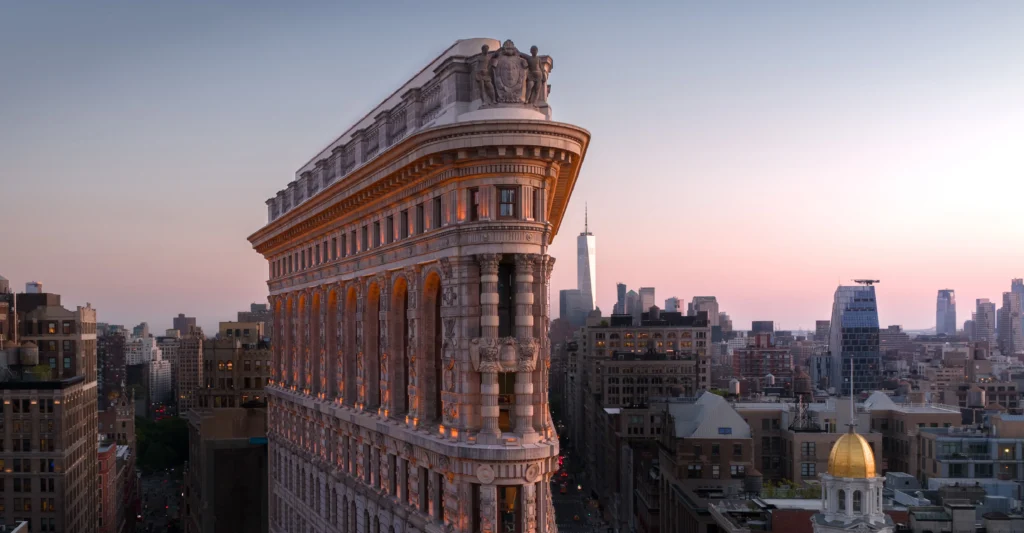
For more than a century, the Flatiron Building has been one of those rare pieces of New York architecture that belongs to everyone.
You may never have stepped inside it, but you know it.
Its unmistakable triangular silhouette has appeared in photographs, films, paintings, postcards, and countless images of the Manhattan skyline. Standing at the intersection of Fifth Avenue and Broadway since 1902, the Flatiron became so synonymous with its surroundings that an entire neighborhood took its name.
Now, 124 years later, New Yorkers are about to experience the landmark in an entirely new way.
For the first time in its history, the Flatiron Building is becoming home.
From New York Office Building to New York Residence
Originally known as the Fuller Building, the Flatiron was designed by Daniel Burnham and completed in 1902 as one of the city’s pioneering steel-frame skyscrapers. New York City designated it an individual landmark in 1966, and it later became a National Historic Landmark.
For generations, however, its purpose was decidedly less romantic than its appearance.
It was an office building.
That era began winding down when Macmillan, its last major tenant, departed in 2019, leaving much of the building vacant. After years of uncertainty and a highly publicized 2023 auction saga, a partnership including The Brodsky Organization and Sorgente Group began transforming the landmark into luxury condominiums.
And this isn’t simply an office building with apartments inserted into it.
The Flatiron is being reinvented.
Living Inside a New York Landmark
Behind the landmarked Beaux-Arts façade, much of the former interior was stripped away, allowing the building to be reconstructed for residential life while preserving the architecture that makes the Flatiron instantly recognizable from the street.
Studio Sofield was brought in to design the interiors, working with one of the building’s most unusual characteristics rather than against it: its shape.
The wedge-shaped floorplate creates residences unlike almost anything else in Manhattan. Many floors have been divided into just two homes, one facing north and another south, while upper levels include expansive full-floor residences. The development currently comprises roughly three dozen luxury homes, with some residences combined during the sales process.
The building is also getting something its early-20th-century architects certainly weren’t planning for: a full luxury amenity package.
Residents will have access to amenities including a 60-foot lap pool, fitness center, sauna, cold plunge, billiards room, and residents’ lounge.
But perhaps the ultimate amenity is the address itself.
This isn’t a new building designed to evoke old New York.
It is old New York.
Buyers Are Responding
If there were any question about whether buyers would embrace living inside one of the city’s most recognizable landmarks, the market appears to be answering it.
As of mid-August, 18 of the 22 residences that had been publicly listed were reportedly already spoken for, representing approximately 82% absorption among those publicly marketed homes. Importantly, additional residences have not yet been publicly released.
The prices are equally extraordinary.
Residences have been marketed from just under $11 million, while the penthouse has been asking $58.5 million. A four-bedroom residence asking $23.95 million went into contract in August, following another major contract for a seventh-floor residence that had been asking $30.5 million.
Residents are expected to begin moving in this fall, with the full amenity package anticipated to open in early 2027.
But beyond the eye-catching prices, the response to the Flatiron may say something larger about what today’s luxury buyer wants from New York.
The Return of the Iconic Building
For years, Manhattan’s luxury market was largely defined by what was new.
New towers. New architecture. New amenities. New views.
And there will always be a market for that.
But the Flatiron represents something different: the value of an address that already has a story.
You cannot build another Flatiron Building.
You cannot manufacture 124 years of history, recreate the building’s place in popular culture, or replicate the feeling of looking through your window and realizing you’re standing inside a structure recognized around the world.
In a city filled with extraordinary new development, history itself has become a luxury.
A Bigger Shift for Manhattan
The Flatiron conversion also arrives as New York is having a much broader conversation about what should happen to its aging and underused office buildings.
Remote and hybrid work changed the relationship between Manhattan and its commercial real estate. At the same time, the city continues to face enormous demand for housing.
That has made office-to-residential conversion one of the most closely watched areas of New York development.
A recent Flatiron/NoMad Partnership study estimated that 10% to 20% of office space within the district could potentially convert over time, which could produce approximately 3,400 to 6,800 residential units over roughly two decades.
Most of those conversions, of course, will look nothing like the Flatiron.
But the principle is fascinating.
New York’s buildings don’t necessarily need to disappear when the way we use the city changes.
They can change with us.
Preserving New York by Letting It Evolve
New York has always been a city that rebuilds itself.
Sometimes that means constructing something entirely new. Other times, it means looking at something we’ve had for generations and imagining a different future for it.
The Flatiron Building may be one of the clearest examples yet.
The exterior that generations of New Yorkers recognize remains. Its limestone and terra-cotta façade has been meticulously restored, roughly 1,000 windows have been replaced to landmark preservation standards, and the building’s famous silhouette continues to anchor Madison Square.
But behind those walls, an entirely new chapter is beginning.
Soon, lights will turn on at night not because someone is working late at the office, but because someone is home.
And there is something wonderfully New York about that.
The Flatiron isn’t becoming less iconic by becoming residential. It is simply finding a new way to remain part of the city.
At The Garson Team, we’re endlessly fascinated by the buildings, neighborhoods, and people that make New York unlike anywhere else. Because in this city, real estate has never just been about square footage.
Sometimes, you’re buying a piece of New York history.
Related reading: From Offices to Apartments: How “City of Yes” Is Transforming Manhattan’s Skyline.